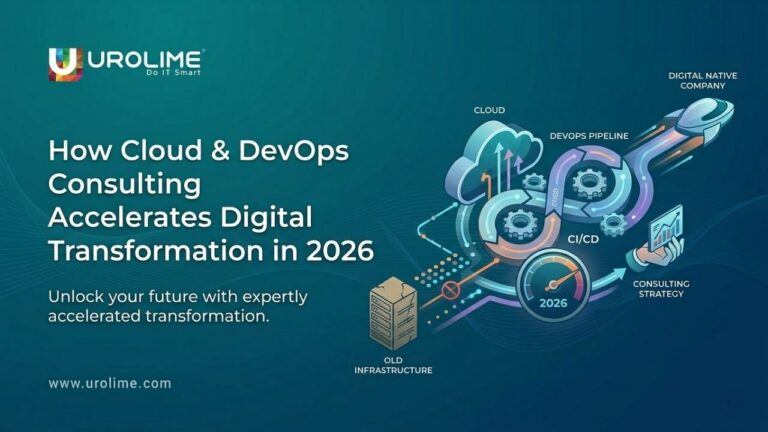
Digital transformation in 2026 has moved beyond the experimentation phase to an implementation phase. It is now a board-level mandate that is driven by AI acceleration, evolving cybersecurity threats, distributed workforces, as well as rising customer expectations. Organizations are no longer confused on the question- whether to modernize, rather they are asking how fast they can do it-without compromising security, compliance, or operational stability.
Cloud as well as DevOps consulting have emerged as the primary accelerators of this transformation. When executed with a proper strategy, this really makes an impact. They enable enterprises to innovate continuously, scale intelligently, and operate with measurable efficiency.
Digital Transformation in 2026: What Has Changed?
Several macro trends are redefining digital transformation:
- AI-native application development
- Platform engineering adoption
- DevSecOps as a default practice
- Increased regulatory scrutiny as well as data sovereignty requirements
- FinOps-driven cloud cost optimization
- Shift toward product-centric operating models
Today, digital transformation is less about migrating infrastructure and more about redesigning enterprise architecture for agility, automation, as well as intelligence.
This is where a comprehensive digital transformation service in US becomes critical. It ensures modernization efforts are structured, measurable, as well as aligned with long-term business outcomes rather than short-term technical upgrades.
Cloud Consulting – The Strategic Foundations
By 2026, the cloud will not only be just about infrastructure, but about the operating model of a modern business.
Expert cloud consulting will help organizations achieve:
– Design Cloud-Native Architectures
Modern applications and systems operate as microservices, containers, serverless, and API-centric ecosystems. Here, consulting expertise will be applied in rebuilding or re-engineering old applications or systems of record as microservices-based applications or systems of engagement.
– Implement Hybrid and Multi-Cloud Strategies
Organizations will be deploying their applications and systems across multiple cloud platforms for increased resiliency, vendor independence, and regulatory needs.
– Optimize Cloud Economics with FinOps
Cloud economics is a key area of focus for any organization’s CFO. FinOps will provide real-time visibility, allowing for cost optimization without compromising innovation.
– Improve Security and Compliance
Security models will be built around concepts of zero-trust, encryption-by-default, identity federation, and continuous automation of compliance.
A digital transformation service will bring all these threads together as a unified roadmap, with a specific focus on a US-based organization.
DevOps Consulting: Enabling Continuous Innovation
If cloud is the foundation, DevOps is the execution engine.
What is DevOps in 2026?
A highly automated, AI-driven, and integrated software development and deployment model, with security built in at every level. The companies using mature DevOps practices are those that deliver frequently, recover quickly, and deliver a better customer experience.
A dedicated devops consulting service in the US helps enterprises achieve:
- Intelligent CI/CD Pipelines
CI/CD pipelines are highly automated, with tests, security, and even AI-driven anomaly detection. Deployment cycles are now measured in hours, and not weeks.
- Infrastructure as Code (IaC)
IAC helps enterprises manage their infrastructure as code, making it auditable, reproducible, as well as predictable.
- DevSecOps
DevSecOps is a key part of every enterprise’s software development lifecycle, detecting security vulnerabilities early on in the development cycle.
- Observability and Reliability Engineering
Observability and reliability engineering are key areas of focus, with distributed tracing as well as Site Reliability Engineering (SRE) becoming increasingly important.
- Platform Engineering Enablement
In a modern enterprise, internal developer platforms are becoming increasingly important. Here enterprises are building their own developer platforms to enhance developer productivity.
Accelerating Time-to-Market Without Increasing Risk
In 2026, speed and agility will be the differentiator. Yet speed and agility without proper governance will only lead to chaos. The combination of cloud platforms as well as DevOps consulting services will provide a stable foundation that enables:
– Faster feature releases
– Secure experimentation with automated rollback
– Scalability to meet sudden surges
– Reduced downtime with automated recoveries
AI and Automation at the Core
Digital transformation is synonymous with AI today. Cloud infrastructure is the space where AI can scale, and DevOps becomes MLOps to ensure the transition from experimentation to production is seamless. Consulting services help organizations:
– Operationalize AI workflows
– Automate engineering processes
– Implement predictive monitoring
– Leverage AI to optimize costs
The result is an intelligent enterprise that is constantly learning and adapting.
Organizational and Cultural Alignment
While technology is the most visible part of the digital transformation process, the organizational and cultural aspects are equally important. In most cases, the consulting process will involve an equal focus on:
– Moving from a project-based to a product-based approach
– Creating DevOps teams that are cross-functional
– Defining key performance indicators that are business-focused
– Embedding agile and iterative methodologies
This is the organizational part of the digital transformation process that will ensure the desired results are achieved.
Strengthening Security and Governance
Cybersecurity risks are increasing, and compliance requirements are becoming more stringent. However, the security infrastructure must be able to keep up with the pace of technological innovations. In the current environment, modern cloud and DevOps consulting services provide:
– Zero trust security in action
– Automated compliance monitoring
– Continuous vulnerability management
– Policy as code-based governance
This means security is integrated into the entire development process, rather than added on as an afterthought.
The Business Impact
For businesses, the positive impact of a well-structured cloud and DevOps consulting strategy is:
– Lower operating costs
– Increased deployment rates
– Reduced incident response time
– Improved customer satisfaction
– Enhanced innovation potential
A mature digital transformation service in the US helps businesses connect digitalization initiatives to tangible business outcomes. Similarly, a strategic DevOps consulting service in the US helps businesses transform their engineering operations into a high-performance delivery machine.
Conclusion
In the year 2026, digital transformation is no longer just about technology adoption; rather it involves architectural design, automation of operations, cultural alignment, as well as maturity in governance. Cloud consulting services provide the foundation, while DevOps consulting services provide the thrust. With the help of cloud and DevOps consulting services, businesses can transform their operations with confidence and stay ahead in the increasingly digitalized global economy.
Those businesses which are undertaking digital transformation through integrated cloud and DevOps consulting services are not just modernizing their technology; they are revolutionizing the way their businesses work and the way they deliver value to their customers.