Digital transformation has fundamentally transformed the way we design, deploy, and run applications. TCloud-native architectures, microservices, containers, as well as distributed systems have brought unprecedented agility – but with complexity. The old-school way of doing IT operations, where we use human effort and reactive monitoring, is no longer sufficient. This is where AIOps (Artificial Intelligence for IT Operations), which is turning the world of IT operations upside down.
From smart monitoring systems to self-healing systems, AIOps is changing the world of IT operations very seriously. In this post, we will explore the world of AIOps and its implications on the world of IT operations.
What is AIOps?
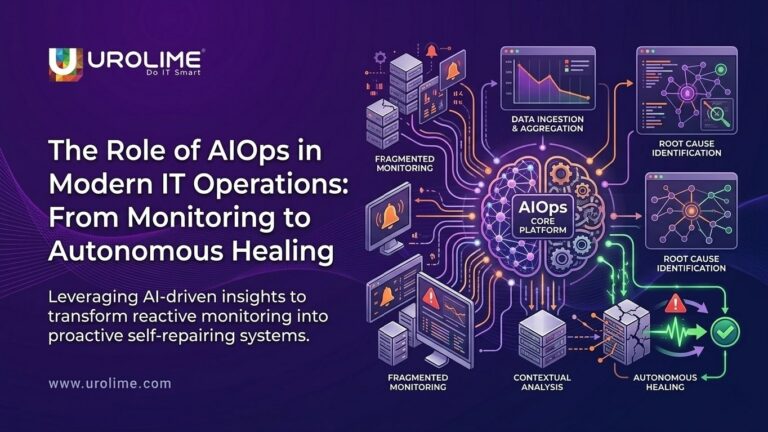
AIOps is the use of Artificial Intelligence (AI) and Machine Learning (ML) technologies to automate and enhance the world of IT operations. AIOps processes vast amounts of operational data, such as logs, metrics, traces, as well as events, and applies advanced analytics techniques to:
– Identify anomalies in real-time
– Identify relationships between related events
– Predict incidents before they occur
– Automate remediation of issues
In other words, AIOps is the process of converting raw operational data into actionable insights.
The Evolution: From Monitoring to Intelligence
- Traditional Monitoring (Reactive)
Earlier, IT teams relied on alerts from basic thresholds: “CPU above 80%,” “memory spike,” “app crashes,” and so on. It was fine when everything was small and static, but it doesn’t scale when dealing with distributed, cloud-native environments where thousands of metrics fluctuate up and down all the time.
- Intelligent Monitoring (Proactive)
Then came AIOps, which uses intelligent monitoring that learns about its environment: “What’s normal?” “How do I dynamically change thresholds?” “How do I use machine learning to detect anomalies?” It also correlates events from different systems, which reduces fatigue and increases detection speed (reduced MTTD).
- Autonomous Healing (Predictive as well as Self-Remediating)
The most advanced stage of AIOps: systems can heal themselves – restart failed services, scale infrastructure, roll back bad code, and optimize workloads in real time.
Why AIOps Matters in Today’s IT Environments
- Cloud-Native Complexity
Cloud environments produce enormous volumes of telemetry data. Manually processing this information is not feasible. AIOps can assist with this challenge in several ways:
– Aggregating across multi-cloud observability data
– Identifying hidden performance bottlenecks
– Optimizing cloud costs
– Ensuring zero downtime
Organizations that are utilizing Cloud automation services in the US are increasingly adopting AIOps solutions to automate their infrastructure provisioning, policy implementation, and performance optimization.
- Kubernetes and Containerized Applications
Kubernetes is designed to be dynamic and constantly changing. Pods scale up and down rapidly, and services are constantly being created and destroyed. Microservices are continuously communicating with each other.
AIOps as well as AI-powered Kubernetes monitoring solutions in the US enable IT teams to:
– Identify unusual behavior within pods
– Identify memory leak issues
– Predict node failures
– Automate smart resource optimization
AIOps and AI-powered Kubernetes monitoring solutions are providing reliability without increasing operations overhead.
- DevOps Acceleration
DevOps emphasizes the importance of continuous integration and continuous deployment (CI/CD). However, speeding up these processes also increases the risk of operations failures.
AIOps and Managed DevOps services in the US are providing IT teams with the following benefits:
– Intelligent monitoring of CI/CD pipelines
– Rollback features
– Real-time risk scoring for deployments
– Continuous feedback loops
This symbiotic relationship between development velocity and operations reliability is what allows for the true creation of a DevOps culture.
Key Advantages of AIOps
- Fewer Outages: Predictive analytics identify early warning signs. This helps to prevent outages from happening in the first place.
- Lower Operating Costs: Automation eliminates manual processes. It also minimizes resolution time for incidents, as well as optimizes cloud usage.
- Better Decision-Making: Leadership can make better decisions based on data-driven insights on trends as well as performance.
- Better User Experience: Consistent app performance and availability result in a better user experience.
The Business Impact of Autonomous IT
What does AIOps mean to the business stakeholders? To them, it is not just a technology upgrade but a strategic enabler.
- Quicker time-to-market for digital products
- Improved operational resilience
- Improved compliance as well as governance
- More scalable infrastructure to accommodate growth
As businesses continue to expand their digital presence, Autonomous IT Operations will be a key differentiator for them.
Challenges in Implementing AIOps
The benefits of AIOps are undeniable. However, to implement it successfully, there are certain challenges that have to be overcome:
- High-quality as well as clean data
- Integrated observability platforms
- Cross-functional collaboration
- A strong automation strategy
The implementation of AIOps will have to be aligned to the overall cloud strategy and DevOps initiatives.
The Road Ahead: Embracing Fully Autonomous IT
In the future, IT operations might not only sense what is going on but might also have the capability to think on their own and perform actions such as resolving issues and protecting themselves against threats without human intervention.
The big IT players in the US are taking this trend forward by embedding AI in all aspects of IT operations, such as advanced Managed DevOps, AI-powered Kubernetes monitoring, and various forms of Cloud automation services.
Conclusion
Modern IT operations demand more than visibility -they require intelligence.
AIOps bridges the gap between monitoring as well as autonomous healing by combining AI-driven analytics with automated remediation. It empowers organizations to move from reactive troubleshooting to predictive, self-healing systems.
For businesses which are navigating through complex cloud-native ecosystems, AIOps is no longer an option- It is the foundation that builds resilient, scalable, and future-ready IT operations.