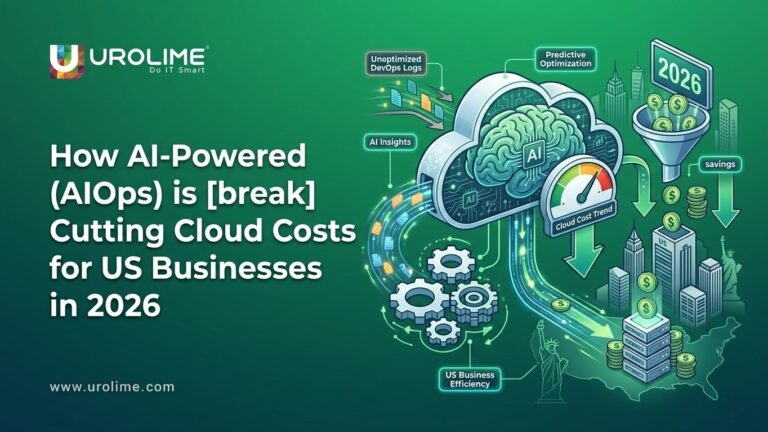
Cloud computing has transformed the method in which companies build and scale digital products. However, for many businesses in the US, cloud costs are increasing beyond expectations. This incur unnecessary costs due to unused resources, scaling policies, and even incident detection. In 2026, businesses are making use of AI-powered DevOps (AIOps) to help reduce unnecessary costs. With AIOps Cloud Cost Optimization, businesses are not only improving their product reliability but also cutting costs in their cloud environments.
This article aims to provide information on how AIOps Cloud Cost Optimization is helping US businesses reduce costs in their cloud environments, how AI is being used to reduce AWS costs, and how DevOps partners are helping businesses implement a smarter FinOps strategy.
The Rising Need for AI-Driven Cloud Cost Optimization
Cloud computing has a solid impact on businesses in recent years. Businesses in different industries, such as fintech, healthcare, SaaS, and even e-commerce, are making use of cloud computing to develop as well as deliver their products.
However, with cloud flexibility comes cloud costs, and many businesses are incurring unnecessary costs in their cloud environments. Some of the common cloud costs include:
- Over-provisioned compute resources
- Unused resources running 24/7
- Inefficient auto-scaling policies
- Lack of visibility into multi-cloud environments
- Delayed incident detection leading to downtime
Traditional monitoring tools can detect when a problem occurs in a cloud environment, but they are not efficient in predicting problems before they happen. AIOps is a revolutionary technology that is changing the way businesses design and develop their products. With AIOps Cloud Cost Optimization, businesses are not only improving their product reliability but also cutting costs in their cloud environments.
How AIOps Detects Anomalies as well as Prevents Costly Outages
For cloud environments, the largest cost risk is unexpected outages. These not only impact revenue but also drive costs for emergency fixes and rapid scaling.
AIOps solutions process massive amounts of operational data, including:
– Infrastructure metrics
– Application performance metrics
– Logs as well as events
– User behavior trends
With powerful anomaly detection capabilities, AIOps solutions can identify subtle changes that human analysts might miss.
Some of the major features of AIOps solutions are:
– Predictive Anomaly Detection:
AI can identify unusual dips and spikes in CPU, memory, and network usage, which are often precursors to system crashes.
– Automated Root Cause Analysis:
Instead of wading through countless alerts, AIOps solutions can automatically identify the root cause of system performance issues.
– Self-Healing Automation:
The system can automatically react to issues as well as restore the normal operation.
These capabilities significantly reduce the Mean Time to Detect (MTTD) as well as Mean Time to Repair (MTTR), which are useful in preventing costly outages and wastage of resources.
Practical Approaches to AWS Cost Reduction with AI
For businesses that are currently leveraging Amazon Web Services as their cloud-based environment, AI-based DevOps is quickly becoming a necessity in order to keep costs of infrastructure under control. AWS Cost Reduction with AI is a concept that is based on a comparison of usage with AI, in order to optimize costs. Below are some of the most common AI-based approaches:
Intelligent Resource Rightsizing
DevOps tools that are AI-based will be analyzing long-term usage patterns and provide recommendations based on that. Most businesses end up overspending on resources since they are not utilized to their maximum potential. AI-based resource rightsizing reduces computation costs significantly without compromising performance.
Predictive Auto-Scaling
Unlike auto-scaling, which is reactive in nature, AI-based auto-scaling is predictive in nature and is based on patterns of usage in order to scale resources appropriately.
Spot Instance Optimization
Machine learning is useful in identifying resources that are suitable for spot instances, thus allowing businesses to take advantage of idle resources that are offered at a significantly reduced price compared to regular resources offered by AWS.
Storage Lifecycle Optimization
Machine learning is useful in moving data that is not frequently accessed to a storage environment that is significantly cheaper, such as archival storage.
The Role of Managed DevOps Services in Cloud Cost Management
While AIOps solutions offer significant advantages, using them effectively requires proficiency in cloud architecture, automation, as well as FinOps. This is where businesses are seeking expertise in Managed DevOps Services in US. which usually include:
– Cloud Cost Management as well as Optimization
– AI-based Observability and Anomaly Detection
– Infrastructure Automation along with CI/CD Optimization
– Security and Compliance Management
– Performance Optimization across multiple Clouds
Working with experienced DevOps teams can help to establish frameworks that would implement AIOps solutions without disrupting current processes. For example, companies can work with experienced DevOps teams to help businesses in the US utilize AI-based monitoring solutions, automate infrastructure optimization as well as develop frameworks to ensure cloud expenses are under control.
FinOps in 2026: A Practical Guideline
With an increase in cloud usage, FinOps has turned out to be a much needed exercise for tech teams to tie cloud spending to accountable budgeting. For organizations to thrive in 2026, a few essential FinOps practices have to be adopted.
Cross-Functional Cost Visibility
To ensure visibility of cloud spending data to engineering teams, finance teams, and operations teams through shared dashboards is an essential practice of FinOps.
AI-Enhanced Cost Forecasting
Using AI-powered forecasting models to anticipate cloud spending through historical data is another on demand practice of FinOps.
Optimization
Cloud cost management is an ongoing task where AI-powered systems will monitor cloud workloads as well as identify optimization opportunities.
Governance and Policy Automation
Using AI-powered policy automation to enforce cost controls such as auto-shutoff on idle resources or auto-rejection of oversized instances which is an essential practice of FinOps.
With AIOps Cloud Cost Optimization, organizations can adopt all of these FinOps practices to successfully grow cloud infrastructure while maintaining financial discipline.
Conclusion: Why AI-Powered DevOps Is the Future of Cloud Efficiency
With an increase in complexity of cloud infrastructure, it is not suggested to rely just on manual monitoring and cost controls. AI-powered DevOps is a required practice that creates a more efficient operating model to identify areas of inefficiency and optimize cloud infrastructure. With AI-powered DevOps platforms, organizations can adopt AWS Cost Reduction as well as Managed DevOps Services to transform cloud infrastructure from a cost center to a growth engine.