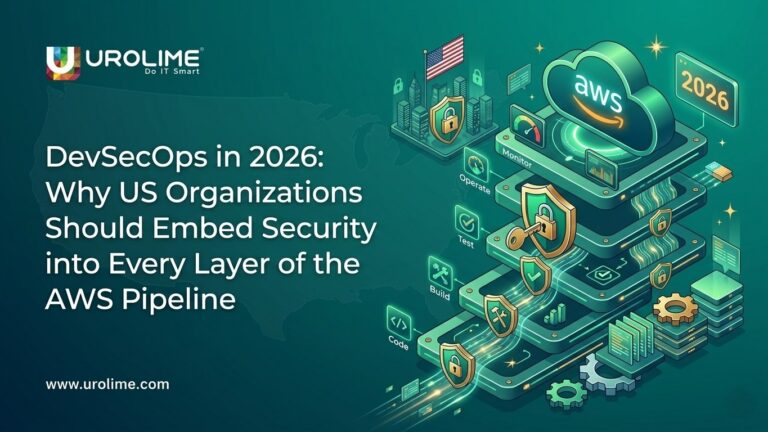
Software development and their deliveries are accelerating faster than ever. Organizations are racing toward cloud maturity and digital transformation. However, security has emerged as a key requirement for ensuring the reliability of software development.
In later 2026, software development will have moved much faster than it is today. It will become much faster thanks to the incorporation of automation, microservices, and cloud-native development. However, the speed of development may bring about new security challenges. DevSecOps is the answer to the security challenges that may come about as a result of the faster software development process.
DevSecOps is a software development practice that incorporates security into every aspect of the development process. It helps to develop secure software without compromising the speed of the development process. For US-based organizations that are already using AWS for their software development and delivery, embedding security into the DevSecOps CI/CD pipeline is the new norm for ensuring the security of the organization’s infrastructure, software applications, and data.
Understanding DevSecOps in AWS Environments
DevSecOps is a concept in which security is integrated into the pulse of the development and operations processes. This is a significant shift from traditional methods, where security is integrated at the end of the process, after the code has been shipped. Instead, security is integrated at every phase of the software development process, continuously, proactively, and in real-time.
In the context of the AWS environment, automated security measures are integrated at every phase, from infrastructure, applications, and the application delivery process. This is exemplified by continuous security scanning, in which the code, containers, and infrastructure are scanned for vulnerabilities in real-time. This is a fundamental shift from the traditional method, in which security scanning is a separate phase.
Another fundamental aspect is infrastructure as code. This is a significant pillar in the context of the AWS environment, in which infrastructure is often automated with tools such as Terraform and CloudFormation. If security is not integrated, a single step in the wrong direction may create doorways for risk. Automated security measures verify the infrastructure with security policies prior to deployment. The best way to achieve this is through a solid association with a DevSecOps consulting firm in the US.
The Value of Shifting Security Left
With many conventional software projects, security was validated only after the release or shortly before. This meant that bugs were being introduced after the code had already been released to users. This is costly to correct and can cause system downtime or increase the likelihood of breaches.
With shift left security, security is addressed in the early phases of the development process. This means that bugs are identified as well as corrected during the coding phase or build phase, not after the application has been released to users.
The advantages of shift left security include:
– Early bug detection: By integrating security validation into the CI/CD pipeline, bugs are identified before the application release.
– Rapid bug correction: Developers are able to rectify bugs during the coding phase.
– Reduced operational risk: By continually running security validation within the CI/CD pipeline, vulnerable code is less likely to be released to users.
With modern DevSecOps pipelines, SAST as well as DAST are integrated, which will help to run automatically -with every code commit.
Kubernetes Security for Cloud-Native Apps
Containerized applications are at the heart of today’s cloud-native computing, and many AWS users take advantage of Kubernetes-based platforms like Amazon EKS to deploy microservices-based applications.Containers offer scalability and flexibility, but they also require robust security measures that can protect these ecosystems.
The following are some of the security measures that can be applied in Kubernetes-based applications:
– Role-Based Access Control
Role-Based Access Control ensures that users and services only have permission to perform tasks that they are assigned to. This can prevent unauthorized users from accessing an account even if they have the credentials.
– Securing Container Images
It is necessary to scan images before they are deployed. This can prevent vulnerabilities from penetrating into the environment.
– Implementing Network Policies
Network policies can control how services communicate with each other in a cluster. This can prevent unauthorized communication between services, thus reducing the attack surface in case there is an unauthorized entry into an environment.
– Protecting Secrets
Sensitive information such as API keys, credentials, as well as certificates should be stored securely using secret management solutions rather than hardcoded into container images.
Securing the AWS CI/CD Pipeline
The CI/CD pipeline is the point at which software delivery speed and security meet in the modern software world. If it isn’t properly secured, it can become a means of attack through which malicious code can be inserted into production.
For those using AWS-based CI/CD pipelines, proper controls over AWS CodePipeline and automated security checks during the deployment process are a must.
A good DevSecOps pipeline should include:
– Automated code scanning with every code commit
– Automated build-time checks of code
– Automated security checks of container images
– Automated scanning of infrastructure configurations
– Continuous monitoring and logging during runtime
Policy as code in AWS
Organizations are increasingly using policy as code in AWS, which means security and compliance policies can be written programmatically and automatically enforced across development pipelines and AWS resources.
Using policy as code in AWS with a Zero Trust AWS environment means all requests and interactions are verified and authenticated.
The Future of Cloud-Native Security
In a world where cloud configurations are getting increasingly complex, security needs to advance right along with it. Today, the success of cloud-native security is based on a company’s ability to understand that it is a never-ending process. DevSecOps as a service– enables companies to deliver software quickly while maintaining security for AWS, containers, as well as CI/CD pipelines. By integrating security testing, Kubernetes best practices, along with policy-based governance, companies can build an effective cloud system that will drive future growth.
To wrap up, in a dynamic cloud environment, integrating security into each step of the AWS pipeline is no longer a choice, rather it is a fundamental requirement for secure as well as agile software delivery.