Introduction
In a phase where Artificial intelligence is actively operational in the industries across the United States, enterprises are moving aggressively to productionize AI systems. Yet, the ground reality is – many businesses are encountering a fundamental constraint: infrastructure maturity has not kept pace with AI ambition.
Though organizations invest heavily in models as well as data, they often rely on fragmented DevOps and cloud practices that were never designed for GPU-intensive, continuously evolving AI workloads. This gap has increased the demand for more integrated approaches like devops consulting services in USA , where the focus is shifting from tooling to platform-level thinking.
This is where AI-native platform engineering emerges itself as a strategic necessity.
The Infrastructure Reality: Fragmentation at Scale
Despite advancements in cloud ecosystems, most enterprises still operate with:
- Underutilized GPU clusters
- Disconnected MLOps as well as DevOps pipelines
- Inconsistent deployment workflows
- Limited visibility into cost and performance
Even organizations making use of mature cloud stacks such as aws cloud consulting services in USA often struggle to unify AI workloads under a coherent operational model.
The result is predictable: increased costs, slower delivery cycles, as well as operational friction across teams.
From DevOps to AI-Native Platforms
Traditional DevOps practices, irrespective of how it is implemented -internally or through devops consulting companies in USA, have optimized application delivery. However, AI introduces new dimensions:
- Stateful as well as data-dependent workloads
- High-cost compute (especially GPUs)
- Continuous model retraining and monitoring
- Complex compliance and governance requirements
These demands necessitate a shift toward Internal Developer Platforms (IDPs) designed specifically for AI systems.
Defining the AI-Native Internal Developer Platform
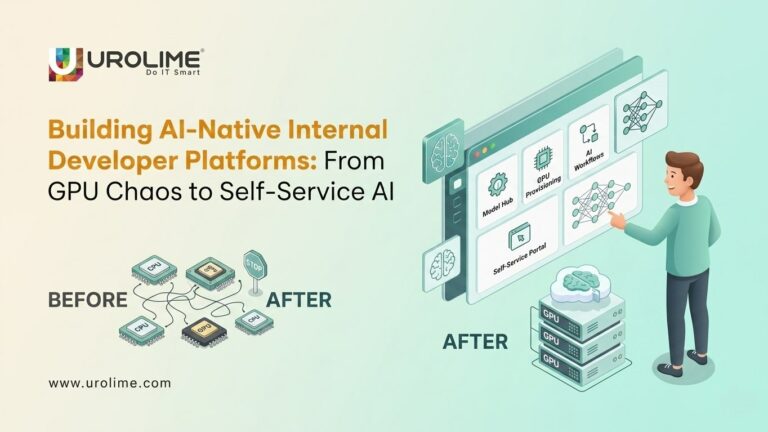
An AI-native IDP is not simply an extension of DevOps; rather,it is a productized platform layer which abstracts infrastructure complexity while standardizing the AI workflows.
It enables organizations to:
- Provide self-service capabilities for AI teams
- Enforce governance as well as security by design
- Optimize resource utilization across workloads
- Deliver consistent developer experiences
Core Architecture of an AI-Native Platform
- Compute and Orchestration Layer
At the foundation lies container orchestration, typically powered by Kubernetes. However, AI workloads demand more than standard orchestration where they require GPU-aware scheduling, workload prioritization, as well as dynamic scaling.
Cloud-native services such as amazon elastic kubernetes service in USA are frequently used as a base, but without a platform abstraction, the reality is that they fail to address higher-order concerns like multi-tenancy and cost efficiency.
- Model Lifecycle Management
As AI systems evolve continuously, it requires a solid lifecycle management plan with:
- Training pipelines
- Version control as well as lineage tracking
- Deployment strategies for batch along with real-time inference
- Rollback and experimentation frameworks
A well-designed platform integrates these capabilities into standardized workflows, which eliminates inconsistencies.
- Developer Experience as a Primary Consideration
Another aspect that is often disregarded regarding AI infrastructure is the developer experience.
High-performance AI infrastructures consider the following important aspects:
- Developer self-service for deploying models
- “Golden path” solutions for frequent use cases
- Templating in addition to API capabilities
- Documentation plus onboarding processes
This transition reflects industry-wide changes observed in companies using the services of cloud consultants, where developer productivity is considered an output metric or a key performance indicator.
- Observability, Costs, and Governance
AI workload operations bring distinctive challenges:
- Model drift and performance issues
- Variations in latency in inference pipelines
- Expanding costs of the underlying infrastructure
Newer platforms include observability, cost management, and governance as a single layer. This becomes extremely crucial for large enterprises using managed IT services.
How MLOps Is Insufficient on Its Own
MLOps has made substantial progress towards ensuring consistency as well as standardizing machine learning processes. Yet, it tends to be tool-focused rather than platform-oriented.
Some of its drawbacks include:
- Fragmented user experiences
- Lack of integration with enterprise systems
- Inadequate cost optimization features
- Weak self-service abilities
AI-driven platform engineering helps overcome all of these issues by treating the underlying infrastructure as a unified product and not a set of tools.
Impact of Platform Engineering on Business: From Optimization to Competitive Edge
Adoption of AI-driven platforms helps businesses gain from:
- Faster deployment of AI models into production
- More efficient use of GPUs and other hardware
- Higher productivity among developers
- Better governance along with compliance
All of these benefits have become deciding factors when enterprises are choosing partnerships and even aws devops consulting services providers – favoring platform-focused companies.
Design Principles for AI-Native Platforms
To build a sustainable and scalable platform, organizations should focus on:
- Abstraction with flexibility
Simplify workflows without restricting advanced use cases
- Opinionated golden paths
Standardize common patterns to reduce complexity
- Cost visibility by default
Make cost a first-class metric in every deployment
- Platform as a product mindset
Continuously evolve based on developer feedback and usage data
Common Pitfalls to Avoid
- Treating platform engineering as a one-time infrastructure project
- Overengineering
- Ignoring cost considerations
- Focusing on tools instead of workflows
- Underestimating the importance of user experience
Conclusion
AI is no longer constrained by model capability- but it is constrained by infrastructure design.
AI-native internal developer platforms represent the next evolution of platform engineering, enabling organizations to move beyond fragmented systems toward cohesive, scalable, as well as developer-centric environments.
For enterprises operating in the US market, where cost efficiency, speed, and governance are paramount, this shift is not at all optional—it is foundational.