As cloud adoption is growing faster by the day, businesses now face the challenge of keeping their cloud spend in check without compromising their innovation momentum. Though cloud platforms bring flexibility as well as scalability to businesses, most find themselves struggling with its inefficient utilization, overprovisioning, and increased complexity, which results in increased cloud costs.
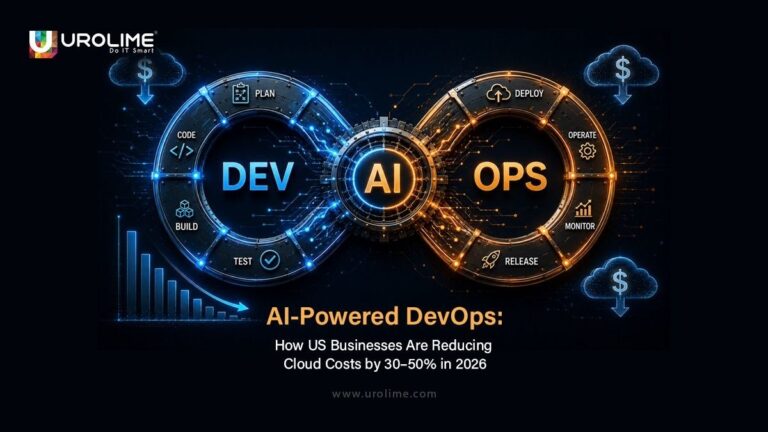
In 2026, AI-powered DevOps has emerged as a strategic solution where AI-enhanced DevOps practices achieve significant savings in cloud costs through automation, along with optimization by 30-50%.
Why Traditional Cloud Cost Optimization Falls Short
Cloud environments are much more complex compared to a few years ago. Businesses today operate in multi-cloud environments, Kubernetes clusters, microservice architecture, and increasing distribution of cloud applications. These are just some examples of what traditional cloud cost optimization measures cannot keep up with:
- Changing demands on resources
- Quick scaling of cloud infrastructure
- Increased cloud resource sprawl
- Overhead associated with cloud management
- Insufficient insight into cloud resource consumption
Businesses need an innovative and more efficient way of managing cloud environments.
DevOps with Artificial Intelligence
DevOps with AI enhances the concept of DevOps as a service through intelligent automation and predictive decision making. In contrast to traditional DevOps, which focuses on reacting to issues after they occur, AI-based DevOps makes real-time analysis of the available data and proactively identifies optimization points before they affect the system’s performance or cost.
Capabilities include:
- Proactive infrastructure scaling
- Predictive resource rightsizing
- Anomaly detection using AI
- Intelligent incident management
- Predicting cloud costs
- Continuous performance tuning
This results in efficient operation of cloud infrastructures.
How AI Is Driving Cloud Cost Reduction
Optimizing Resources
Cloud wastage is caused by over-provisioned compute, storage, and container resources. The use of AI ensures continuous analysis of resource utilization patterns and provision for the right allocation of resources for the infrastructure needs.The benefit is increased utilization rates along with reduced infrastructure costs.
Predictive Autoscaling
Conventional autoscaling platforms are limited to scaling resources when needed to respond to changes in demand. AI systems can predict future changes in workloads and respective to that they can provision resources. This way, organizations can operate efficiently as well as reduce consumption when there is little demand.
Efficient Kubernetes Management
With Kubernetes gaining popularity and becoming central to cloud-native operations, cluster efficiency management has become an important aspect of cost optimization.
Using AI DevOps platforms, organizations can achieve more efficient deployment and management of containers, nodes, as well as workloads without impacting applications’ performance.
Proactive Problem Detection and Remediation
Downtime and other operational issues can cause cloud cost increases due to spikes in resource consumption as well as the need to spend more effort in resolving those issues.
AI observability platforms detect and correlate events and automatically execute remediation workflows to reduce MTTR.
AI-Enhanced FinOps
FinOps platforms that are augmented with AI capabilities enable organizations to create effective financial governance across cloud environments.
- Advanced analytics provide:
- Real-time visibility on cost
- Anomaly detection on spending
- Budget forecasting
- Recommendations for optimization
- Cost allocation insights
This allows technology as well as finance teams to make data-driven decisions that improve cloud economics.
Why are enterprises investing now?
There are many aspects why the uptake of AI-driven DevOps in the United States is increasing:
Cloud Costs
There is a huge pressure on enterprises to make the most of their technology investments.
Operational Challenges
It is becoming more difficult to manage cloud environments because of the increased automation that is needed.
Talent Shortages
There aren’t enough skilled cloud and DevOps engineers, which is pushing the need for AI-enabled operations.
Accelerated Innovation Cycles
Enterprises need to innovate faster than ever before. This requires achieving high levels of performance and security while controlling costs, and AI-driven DevOps allows you to do all three.
What Comes Next
The next phase of DevOps evolution will be defined by autonomous operations . AI solutions continue to evolve from recommendation algorithms into self-optimizing, automated decision-making solutions that optimize infrastructure and ensure better cloud efficiency. Organizations implementing AI-based DevOps strategies now prepare for an era in which cloud operation becomes more intelligent, predictive, and cost-effective.
Conclusion
Incorporation of AI-based DevOps strategies leads to more efficient use of cloud computing capabilities. Businesses operating complex cloud environments and seeking to harness AI-based DevOps practices must look to experienced partners who offer devops consulting services in the USA. Through smart automation, predictions, and observability of operations, companies can reduce costs by 30-50%, improve cloud efficiency, and benefit from a number of other advantages.