Introduction
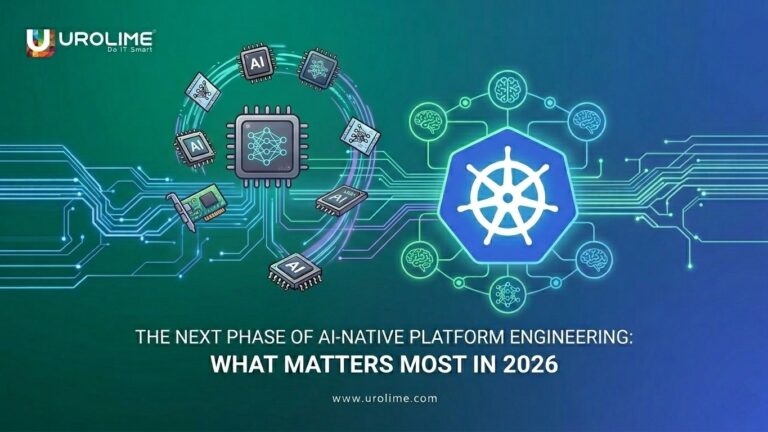
AI-native platform engineering has evolved from a conceptual framework into something with critical enterprise capability at a very quick pace. However, as adoption matures across the US market, the conversation is shifting. The question is no longer about whether organizations should build Internal Developer Platforms (IDPs) for AI- but rather it’s about what capabilities truly matter in 2026, and where should enterprises focus next?
This next phase is being shaped by different aspects like the cost pressure, requirement on governance ,along with the need for production-grade reliability at scale.
- Cost-Efficient AI Platforms Will Be a Must-Have
Cost considerations represent the biggest challenge to AI platform adoption in 2026.
With its resource-intensive workloads, continuous inference, and intensive training, AI has become one of the most costly domains of engineering. where businesses cannot afford to tolerate any inefficiencies at any cost. Therefore, organizations increasingly align their platform architecture with devops consulting services to incorporate cost-consciousness straight into their deployment pipelines.
Changes involve:
- Cost visibility for each model as well as workload in real time
- Dynamic cost-based scaling policies
- Optimized workload scheduling
Cost is no longer a post-fact metric—cost efficiency will shape the architecture.
- Kubernetes as the Control Plane for AI
The continued dominance of Kubernetes within the landscape of AI infrastructures persists. In 2026, the progress will be no longer on adoption, but rather on optimization and abstraction. The use of a Kubernetes consulting service in the USA to facilitate complex platform-based orchestration is increasingly common among enterprises.
Such initiatives emphasize:
- GPU-aware scheduling and packing algorithms
- Isolation of multi-tenant workloads for AI
- Unified standardized deployments within regions
The Kubernetes platform no longer provides infrastructure alone—it provides an operational ecosystem.
- The Convergence of AI Governance & DevSecOps
The rising regulatory pressure and corporate risks surrounding AI have made governance one of the key pillars of the platform approach to artificial intelligence.
Security can no longer be added to a platform in layers, but should rather be embedded within it. The adoption of devsecops consulting services has been fueled by such considerations:
- Policy-as-code for AI deployments and access control
- Auditing of AI models’ lifecycles
- Compliance enforcement within the pipeline of operations
- Cloud-Agnostic Platforms and Strategic Flexibility
Vendor lock-in concerns are intensifying, especially among big businesses that are operating within multiple regions and clouds. In sync with that, there is an increased emphasis on abstraction as well as collaboration with cloud consultants -when building portable platforms.
Examples of new trends include:
- Standardized APIs for interfacing with infrastructure
- Infrastructure as code for installations which can be reproduced
- Decoupling platform functionality from cloud services
Agility has moved beyond being a nice-to-have into a necessity.
- Developer Experience as the Differentiator
One of the most definitive trends of 2026 is the acknowledgment that platform engineering is all about developer experience. Businesses are approaching their platforms as products, sometimes even leveraging managed IT services to enhance ongoing performance and reliability.
Attributes of a good platform:
- Self-service features for deploying machine learning models
- Opinionated “golden paths” to minimize cognitive overhead
- Effective feedback channels using metrics and telemetry
Ultimately, the most effective platforms are the ones that developers actually want to use.
Strategic Convergence
AI-native platform engineering in 2026 cannot be characterized by any particular quality because it involves the convergence of many factors. In previous years, cost, performance, security, and developer experience were all considered independent priorities. They became closely interrelated now.
- Cost and performance are optimized simultaneously
- Kubernetes orchestration is augmented with abstractions to improve usability
- Security becomes inherent part of the workflow itself
- Multi-cloud deployment provides long-term strategic advantages
- Developer experience is the main driver behind platform adoption
It explains why businesses turn to aws devops and kubernetes consulting services to design and implement their platforms rather than implementing separate components independently.
In other words, a company receives an integrated and production-ready system as opposed to a series of disconnected parts.
Conclusion
There are no doubts that in 2026 AI-native platform engineering is about much more than creating robust IT infrastructure.
At the moment, a company cannot be distinguished by its ability to develop AI-based applications. Instead, it depends on whether it can:
- Rapidly deploy new solutions
- Optimize their performance
- Control their operation
To achieve these goals, businesses rely on partners who are providing multiple services and only such an approach makes AI development a successful business practice.