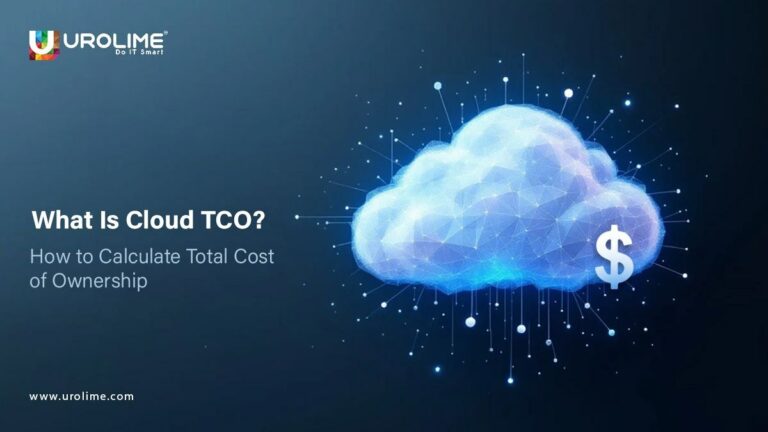
With more and more businesses and organizations moving their applications and infrastructure to the cloud, cost efficiency is becoming as important as performance and scalability. While various cloud platforms offer cost efficiency, the real impact of this effectiveness is not always clear at a simple glance. This is where Cloud Total Cost of Ownership comes in.
Overall, an understanding of Cloud TCO not only enables an entity to focus beyond current costs to determine future costs but makes better business decisions possible for visionary leaders.
What Is Cloud TCO?
Cloud Total Cost of Ownership (TCO) is a financial model that measures the complete cost of owning, operating, as well as managing cloud environments over a defined period. Unlike basic cloud pricing estimates, TCO considers both direct and indirect costs which are spread across the entire lifecycle of cloud usage.
Cloud TCO answers a fundamental question for businesses and IT leaders:
What is the true long-term cost of running workloads in the cloud?
This perspective is essential because cloud expenses extend far beyond compute and storage charges.
Cloud TCO – why it matters
Cloud TCO matters because it provides clarity where cloud billing alone cannot. By grasping the idea of TCO, organizations are able to have better control over expenditures, as well as a bigger ROI.
Key benefits include:
- Complete Cost Visibility
TCO reveals hidden as well as overlooked expenses on- operations, security, and personnel-costs that often accumulate silently over a period of time.
- Smarter Budgeting and Forecasting
Accounting for long-term costs assists finance and IT teams in better planning their budgets through more accurate estimates and avoiding cost overruns.
- Better Cloud Strategy Decisions
Whether comparing on-premises infrastructure to cloud environments or evaluating different cloud architectures, TCO provides a fair gauging.
- Continuous Optimization
A well-defined TCO model will pinpoint the inefficiencies that help teams to right-size resources as well as improve cost governance.
Key Pieces of Cloud TCO
A reliable estimate of the TCO for Cloud infrastructure should include the following areas:
1) Migration and Setup
These expenses includes one-time or short-term expenses related to cloud switching:
- Migrating or modernizing applications
- Data transfer , integrating systems
- Initial Architecture and Setup
- External Consulting or Professional Services
All these costs are temporary and need to be distributed over the lifespan of the cloud.
2) Cloud Infrastructure
The Most Visible Spends, including:
- Compute resources (VMs, containers, serverless)
- Storage services
- Networking and data transfer
- Backup and disaster recovery
The costs are proportional to usage and configuration.
3) Operations and Management
Even if infrastructure is well managed, a variety of ongoing activities will always
- Cloud Operations and Monitoring
- Security, compliance, and identity management
- Performance Tuning and Incident Response
- Cloud Management Tools & Platforms
These recurring charges frequently constitute a significant proportion of the overall long-term TCO.
4) Human Resource and Training Costs
Cloud environments- their management requires skilled professionals. TCO should account for:
- Cloud consulting engineers and administrators
- Training, certifications, and upskilling
- DevOps and FinOps practices
Skill-related costs are frequently underestimated but critical to successful cloud operations.
How to Work Out Cloud TCO
While exact calculations vary by organization, most Cloud TCO assessments follow a structured approach:
Step 1: Define the Evaluation Period
Select a timeframe, typically 1, 3, or 5 years, to allow for approximation of both short- and long-term costs.
Step 2: Identify All Cost Categories
Inventory migration, infrastructure, operational, and people costs related to your cloud implementation need to be listed .
Step 3: Forecast Usage
Consider growth, peak usage, and seasonal variations. Cloud costs fluctuate based on consumption.
Step 4: Keep an eye on hidden charges
This points to the governance requirements, security tools, downtime risks, as well as the running cost which might not be revealed.
Step 5: Calculate and then Compare
Aggregate costs across a defined time period and then compare them against alternatives like the on-premises infrastructure or other cloud models.
Conclusion
Cloud Total Cost of Ownership isn’t just a number, but a navigation compass for organizations. Indeed, understanding Cloud TCO can create clarity, control, and assurance for various cloud-related decisions taken by an organization. Be it a cloud migration plan, a strengthened cloud environment, or even expansion, a TCO approach is essential for ensuring success and cost-effectiveness through a Cloud Consulting Services Company association.