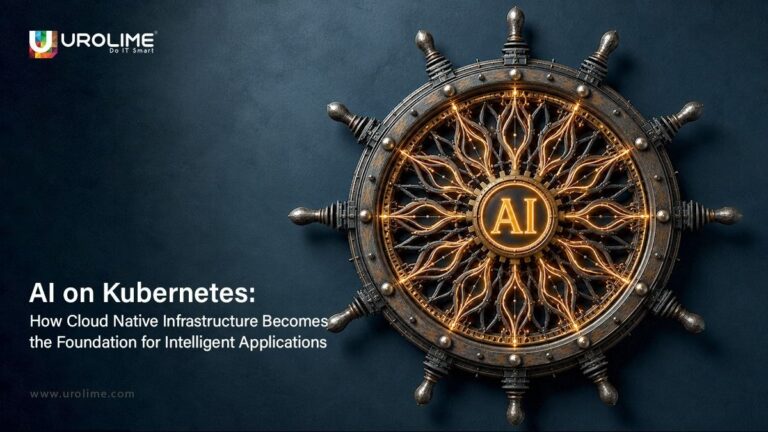
Artificial Intelligence (AI) has grown past its experimental stage and is now becoming a strategic business enabler. With AI-powered customer experiences, predictions, and generative AI technologies, businesses have begun adopting AI solutions to stay ahead of the game.
However, deploying AI at scale requires more than sophisticated AI models and algorithms. To use AI successfully it requires infrastructure that has the capability to handle dynamic workloads, large-scale data processing, as well as continuous deployment.This is where Kubernetes pitches in.
Though created for container management, Kubernetes has evolved to be the best choice for managing modern AI systems. With its scalability, automation, and portability capabilities, Kubernetes consulting services can provide all necessary infrastructure for building and deploying AI applications.
Why AI Needs Cloud-Native Infrastructure
While AI models are at focus, the infrastructure supporting them plays an equally important role. Following are some areas that enterprises have to deal with -who are looking for AI implementation on their solutions:
- High-performing computing
- Training that requires GPUs
- Inference needs
- CI/CD pipeline
- Data processing in large volumes
- Cloud-native and multi-cloud operations
Conventional infrastructures may find it challenging to fulfill these needs adequately. With more AI projects rolling out in other parts of the enterprise, a system that allows dynamic scaling with ease of control becomes paramount.
Why Kubernetes Is Becoming the Platform of Choice for AI
Dynamic Workload Scaling
The nature of AI workloads is unpredictable. Some training processes need massive computing power during their implementation, whereas production inference services should be scalable enough to address users’ changing demands.
The Kubernetes platform allows for automated scaling, purely depending on what the workload demands. This helps companies maximize resource efficiency as well as productivity.
Standardization in Various Environments
It is common that a company will run its operations in multiple environments – on-premises, private clouds, and public clouds. In all these cases, Kubernetes ensures the same level of management and consistency.
Regardless of whether developers choose to use AKS or EKS services offered by Azure and Amazon respectively, they can benefit from the standardization process.
Availability and Reliability
Most of the applications running on the basis of AI technologies facilitate mission-critical processes. Kubernetes continuously monitors the application state, replacing any failing workloads, if necessary.
Enabling AI with Cloud-Native Architecture
Contemporary AI systems have evolved significantly. They are now designed leveraging cloud-native approaches that promote scalability and flexibility.
AI Applications Based on Microservices
In order to make AI application flexible and scalable, businesses have moved away from monoliths toward microservices, thus making it possible to break down AI application into independent pieces such as:
- Data ingestion
- Feature engineering
- Model inference
- Monitoring & Analytics
The services mentioned above are easily managed with Kubernetes, making them scale independently depending on their needs.
MLOps and Continuous Innovation Enabled by Kubernetes
Deploying an AI system is not simply about creating a new model. It implies managing all the components including:
- Data pipeline
- Training
- Testing
- Deployment
- Monitoring
In this respect, Kubernetes helps streamline operations, accelerate model deployment, and automate the entire process.
Kubernetes: Enabler for Enterprises to Build AI Infrastructure
With the increase in complexity of AI models, enterprises require scalable infrastructure. Kubernetes makes it possible with:
- Workload scheduling
- GPU resources optimization
- Horizontal scaling
- Multi-cluster capabilities
- Operational efficiency
All of that enables AI implementation and scaling for businesses.
Security and Governance Aspects
In light of the increasingly important and sensitive business and customer data that AI systems handle, the aspects of security and governance cannot be overlooked.
The following features can contribute to enterprise security when working with Kubernetes:
- Role-based access control (RBAC)
- Network segmentation
- Secrets management
- Policy management and compliance controls
With these capabilities, you can manage your AI environment in a secure and compliant way.
The Future of AI Infrastructure: What Comes Next?
As enterprises explore bigger, better, and more complex ways of utilizing AI, there are certain future trends that should not be neglected. The most promising trends are as follows:
- GPU orchestration
- Cloud-native deployment and integration of AI
- AI-driven optimization of the infrastructure
- Edge computing with the help of Kubernetes
With these future developments, the connection between Kubernetes services and AI will grow stronger as well as solid.
Conclusion
AI is reshaping industries, business models, as well as customer experiences. To unlock its full potential, organizations need an infrastructure platform that delivers scalability, resilience, and operational consistency.
This is where Kubernetes as a service fits the bill.
With Kubernetes, one can achieve automation of orchestration and optimization of resources, thus laying the necessary groundwork for intelligent systems to come into existence. Large count of companies are now looking to Kubernetes as the platform for their AI journey.
Businesses that have cloud-native capabilities and specialized knowledge of AI shall have a definite advantage over others.