For years, DevOps has been the gold standard for building and delivering software faster . It brought revolutionary change to the culture of engineering by removing the barrier that existed between development and operations and adopting automation and CI/CD practices as their mainstays. Companies that adopted DevOps shortened their delivery time from months to days and increased the quality of software while responding to market demands.
However, despite the achievements of DevOps, a new phrase has quickly found its way into boardroom discussions and engineering strategies – Platform Engineering. As stated by Gartner, almost 80% of large software engineering organizations are predicted to set up their platform engineering teams for providing reusable services and self-service for developers by 2026. Is it time to ask the inevitable question – has Platform Engineering replaced DevOps?
The answer goes beyond just a simple “yes” or “no.” Platform Engineering is not about rewriting the DevOps guide.
DevOps Solved Collaboration. Scaling Created a New Challenge.
Initially, when DevOps appeared, the main barrier for software delivery was organizational. Software developers were building the apps while operations specialists took care of the infrastructure; the process itself was cumbersome, non-standardized and unreliable. DevOps revolutionized all these aspects by providing a new model based on shared responsibility, automation and continuous feedback.
Nowadays, however, the situation is completely different.
Modern engineering teams rarely operate with one application deployed to several virtual machines. Rather, they have to deal with hundreds of microservices, Kubernetes clusters, hybrid clouds, Infrastructure as Code, observability systems, compliance checks and even AI-driven engineering workflows. While DevOps methodologies allowed to automate many of these aspects, the number of used technologies and tools is so high that it has become a new cognitive load for developers.
Paradoxically enough, the movement which was created to reduce any possible bottlenecks has created a new one. Modern software developers spend as much time navigating through the deployment pipelines, cloud access rights, infrastructure templates and compliance checks as they spend coding.
This is Why Platform Engineering Shifts the Conversation
Platform Engineering is not about DevOps failing to deliver, but rather that software delivery had become too complicated to rely on developers’ being experts at all aspects of operations.
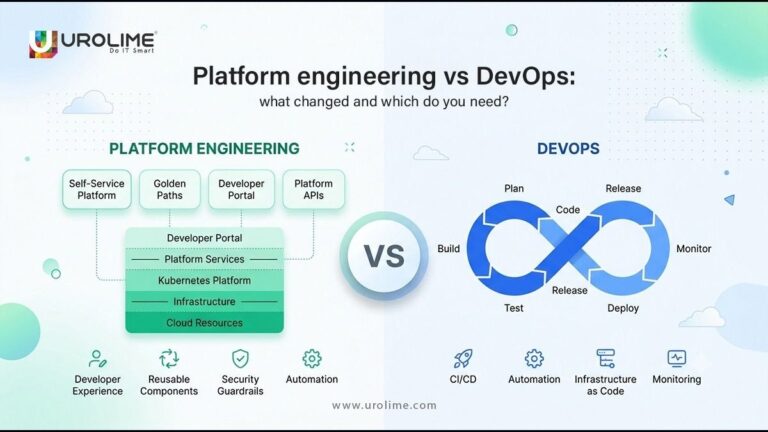
Instead of trying to make engineering teams provision their own deployments, infrastructures, monitoring, and security systems, Platform Engineering services company came up with the idea of an Internal Developer Platform (IDP). Consider it a product within the company, created just for developers—it provides developers with standardized environments, self-service infrastructure, deployment pipelines that can be reused, security guardrails, and automated processes.
The point is not about completely eliminating complexity but about abstracting away from it effectively. Developers have standard ways to provision environments and cloud services, and platform teams take care of governance, reliability, and security.
In other words, Platform Engineering enables developers to have a great developer experience.
Why Platform Engineering Does Not Necessarily Replace DevOps But Supports It
One of the major myths in the IT industry is that companies need to pick either DevOps or Platform Engineering. The truth is, however, that these practices resolve different issues.
DevOps is an operating approach first and foremost. It implies collaboration, automation, and accountability within the software development process. Platform Engineering is a practice in its turn that uses these principles for building reusable platforms that automate software delivery.
The simplest way to describe the difference is the following: DevOps describes how teams operate, while Platform Engineering describes how teams use engineering capabilities.
DevOps could not exist without a culture of automation and continuous delivery, while, in its turn, Platform Engineering would not be possible without DevOps in case of a large engineering organization.
Reasons for Businesses to Invest in Platform Engineering
More than technology trends, it is business considerations that fuel the rising trend in Platform Engineering Services.
Each and every minute that a developer spends configuring the infrastructure, debugging deployment pipelines, and asking for cloud resources is the time that could have been used to generate value for customers. As organizations scale up, repetitive engineering efforts, inconsistent tools, and fragmented deployment processes start impacting their productivity and efficiency.
Platform Engineering solves such problems through the standardization of the software delivery process. Developers get access to self-service features, onboarding gets faster, security is baked into the delivery pipeline, and engineering teams don’t need to reinvent the wheel.
For the sake of the business, this means quicker product releases and better governance among others.
Is Platform Engineering Needed by All Organizations?
No, not always.
In cases where an organization is either a startup or a business with a comparatively small engineering team, DevOps Services which have already been established may give all the necessary capabilities to design, test, and deploy software. In case the infrastructure is not very complicated, and collaboration is the main problem, the creation of a separate platform team will only cause additional difficulties.
But things will change once an organization grows.
If the engineering team has to deal with multiple cloud environments, numerous services, high-level compliance, or increasing Kubernetes deployment, Platform Engineering will be the next logical step. It allows for creating consistency without taking away from developers’ autonomy and providing a base for further innovation.
“The Future Isn’t DevOps vs. Platform Engineering”
The single most important point to take away from this is that the industry is getting the question wrong.
It isn’t Platform Engineering versus DevOps. It’s how to evolve DevOps to meet the needs of today’s modern software engineering.
DevOps revolutionized software delivery through cultural shifts and automation. Platform Engineering is an evolution of DevOps that treats the developer experience as a product—an offering that helps simplify complexity, establish best practices, and innovate on a massive scale.
With cloud-native technologies, AI-powered software development, and distributed architectures increasingly becoming the status quo, companies that combine great DevOps processes with internally developed platforms will be able to deliver software quickly, efficiently, and effectively meet their evolving business needs.
And the future of software delivery won’t consist in abandoning DevOps. It will be all about advancing upon the work DevOps has done.