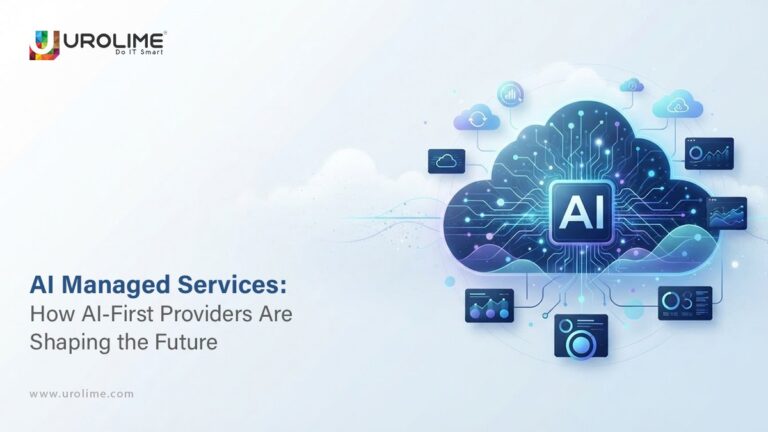
The impact, moreover the influence of artificial intelligence, reaches far beyond software engineering, analysis, and the customer experience. AI is starting to reshape the way technology services are provided, delivered, and optimized.
Traditionally, the Managed Services business model has been based on a known operating model – monitor, detect problems, raise an alert, investigate, and solve the issue. While automation has brought more efficiency, people were key players in decision-making.
AI is changing all that.
By using AI in conjunction with observability, AIOps, automation, cloud technology, cybersecurity, and IT service management, service providers can go from being just reactive to becoming proactive, intelligent, as well as autonomous.
This leads to the emergence of AI-first providers – organizations that don’t just augment their traditional services with AI, but develop new services with AI at its core.
What Are AI Managed Services?
AI managed services make use of artificial intelligence to continuously monitor, analyze, predict, as well as optimize technology environments.
The difference from regular service provision is well illustrated by the process flow of operations:
In traditional system:
Monitor → Detect → Alert → Investigate → Resolve
Rather in AI First system:
Observe → Understand → Predict → Act → Learn
Let us take a case of a server that exhibits abnormal resource usage. In a regular monitoring system, an alert would be sent out to an engineer, calling out for investigation. The AI system can correlate the anomaly with past behavior, applications, workloads, and incidents to see whether there will be a failure.
It can suggest remedial actions or even perform approved and low-risk actions automatically.
The goal here is not to blindly automate technology operations. The goal is to make them more predictive and effective.
From AI-Assisted to AI-First Operations
Service delivery will evolve in steps.
AI-assisted operations
To begin with, AI supports existing processes. It helps to summarize the incidents, analyze the logs, correlate the alerts, suggest solutions, and assist the service desk engineers.
Human decision-makers stay in control while AI helps to make decisions faster.
AI-first operations
This is what comes next.
AI becomes the integral part of the service operating model. The intelligence layer analyzes the operational data collected from the infrastructure, applications, security systems, ITSM tools, cloud services, etc., and determines the proper action to be taken.
Here we have an operational cycle:
Data → Intelligence → Decision → Automation → Outcome → Feedback
Feedback mechanism plays a vital role in this chain. Any incident, its resolution, and service delivery outcome become additional knowledge for further decisions.
What Sets an AI-First Provider Apart?
An AI-first provider is not just a traditional service provider who uses an AI chatbot.
There are three features of this approach.
AI is integrated into service delivery.
AI can be used to affect monitoring, incident management, capacity planning, cybersecurity, service desks, application management, and cloud optimization instead of being a standalone service.
Operational data becomes an asset of intelligence.
The history of incidents, system configurations, performance benchmarks, patterns of resolutions, and service interactions can be used for identifying repeated and emerging problems.
Automation becomes intelligent.
AI must not always execute recommendations without additional checks. Automated execution is fine for low-risk and repeated tasks, while high-impact actions must not be automated.
The point here is thus not people-less IT, but IT with human expertise enhanced with intelligence and automation.
The Technology Foundation
Managed Services in AI
AI managed services need more than just generative AI.
Observability
Metrics, logging, tracing, network telemetry, application performance metrics, and security telemetry provide AI with the operational context necessary to make sense of what is going on.
AIOps
AIOps supports event correlation, alert de-noising, anomaly detection, and pattern recognition in complex technology ecosystems.
Generative AI
Generative AI is a natural-language interface to operational knowledge. Using generative AI, engineers can look into an incident, summarize technical data, interrogate the data, document incidents, and develop possible solutions.
Intelligent Automation
The last piece is taking action. Integrating AI with APIs, orchestration tools, infrastructure as code, and ITSM processes enables the implementation of validated recommendations for remediation.
Data Quality and Data Governance to Determine Success
An AI-first approach is only as good as the data behind it.
Disconnected monitoring tools, incomplete asset inventories, lack of documentation, and disjointed operational data can severely impact the usefulness of AI.
Thus, data readiness is the starting point for being ready for AI.
However, governance is important too. Companies require governance around data access, behavior of models, automation rights, auditability, security, and human interaction.
In addition, the degree of autonomy has to match the risk.
It is okay to autonomously restart a non-critical service. But changing a production database, altering a security policy, or rolling out an important infrastructural change is a very different matter.
AI operations have to be autonomous when appropriate but also accountable by design.
The Future of AI Managed Services
AI is changing both the technology and economics of managed services through intelligent automation. With intelligent automation, providers are able to deal with more complexity without increasing their staffing proportionately. Engineers can concentrate on architecture, security, optimization, and transformation.
It’s becoming apparent that there is a definite path that must be followed:
Monitor → Manage → Predict → Prevent → Optimize automatically
Those who succeed will not be those that have the most features of AI. Instead, it will be those organizations that are able to integrate AI, operational data, automation, and governance into something that provides tangible results.
The new challenge isn’t “How do we get AI into managed services?” It’s “How does managed services need to change once it has AI in its core?”
And that’s leading to the new breed of intelligent operations for services.