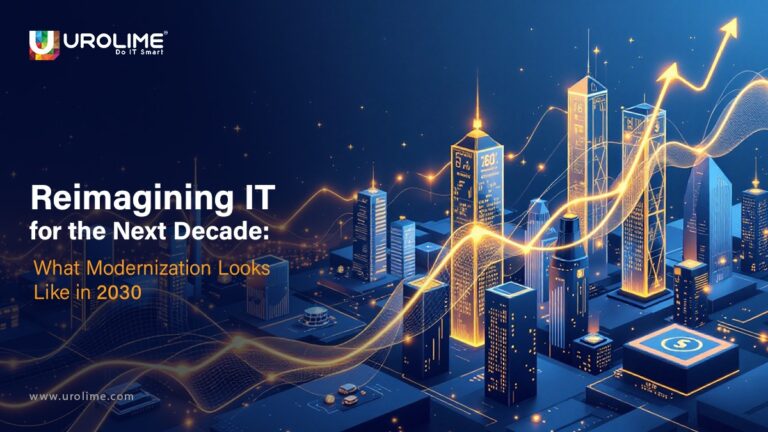
The next decade will redefine how businesses perceive Information Technology. What is traditionally “the cost of keeping the lights on” will now start to transform into a strategic driver of innovation, resilience, and growth. As we approach 2030, IT modernization is no longer optional; rather , it is fundamental to remain competitive in a digital-first economy.
Modernization today is about reimagining how technology drives business results, how it accommodates rapid change, and how it scales with intelligence. Let’s explore what IT modernization will look like in 2030- and what organizations should be doing now to prepare.
IT Modernization Moves From Maintenance to Strategy
By 2030, IT will be fully embedded into business strategy rather than operating as a back-office function. Organizations are shifting away from reactive maintenance toward proactive, outcome-driven technology models. This means building IT environments that are flexible, secure, and capable of evolving alongside the business. Modernization will involve changes in infrastructure, applications, workflows, governance, and the human skills that are brought to the table. Hybrid and multi-cloud environments will be the way to go, which will enable organizations to get the best out of performance, compliance, and cost.
Cloud Migration – A Catalyst for Growth
Moving to the cloud is not just moving stuff from on-prem to off-site servers. It is moving into an era of application modernization-driven migration, redefining applications, securing architectures, and leveraging cloud-native capabilities. By 2030, the strongest cloud strategies will include:
- Put workloads where they matter most to the business
- Speed Up Innovation via Automation & DevOps
- Clearer information about scaling, reliability, and costs
In other words, cloud migration will be less about moving technology and more about achieving business value.
Cloud Managed Services Take the Lead
As the cloud ecosystem becomes more sophisticated and intricate, organizations are recognizing the requirement for specialized expertise within the management process, and hence Cloud Managed Service is gaining more traction. With the inclusion of Cloud Managed Service, organizations will be able to enhance control and visibility without compromising on the management process, and it’s projected that by 2030, it will become an integral part of the IT infrastructure for organizations:
- Cut operational overhead
- Boost Reliability and Performance
- Scale securely across hybrid and multi-cloud environments
This shift allows internal teams to pursue innovation without getting bogged down in infrastructure.
Managed IT Services Become Strategic Partnerships
The role of Managed IT Services is also evolving. It is no longer just the help desk; managed service partners are coming in to be strategic collaborators, to guide companies through the complexities they face, to bridge the skills gaps they have, and to get the modernization efforts off the ground.
Over the next ten years, managed IT services will:
- Support end-to-end modernization efforts
- Assemble cloud, security, and automation expertise
- Continuously optimize and govern IT environments
Therefore, organizations that see managed IT services not just as vendors but as long-term partners will be in a better position to successfully respond to this change.
Automation, AI, and Resilience Define Future IT
By 2030, automation and artificial intelligence will be embedded into everyday IT operations. From intelligent monitoring and predictive maintenance to automated security responses, AI-driven systems will reduce downtime and improve efficiency. What’s equally important, however, is the element of resilience. The new wave of the IT landscape will indeed be designed to withstand disruption, whether or not this disruption originates due to cyber attacks, system failures, or market volatility. As such, what’s going to feature in the modern IT ecosystems will include self-healing infrastructure, recovery, and real-time visibility.
Sustainability and Responsible IT Matter More Than Ever
Sustainability is becoming a critical driver of IT decision-making. Energy-efficient infrastructure, optimized resource usage, as well as responsible cloud adoption are no longer optional considerations. By 2030, organizations will increasingly evaluate IT modernization efforts through environmental, regulatory, and governance lenses by aligning technology strategy with broader corporate responsibility goals.
Looking Ahead: Modernization Is a Continuous Journey
IT modernization in 2030 will not be defined by a single project or technology. In other words, it’s an ongoing journey-languages of cloud computing, managed services, automation, security, and sustainability are all being brought together in one overall strategy that seeks to ensure the needs of the future are addressed today with forward-thinking architectures, trusted managed service partners, and the ability to evolve and grow in the years to come.